Guides Formal table setting
The formal table setting, explained
Fifteen pieces of silver and glass, and not one of them is there to catch you out. Here is the formal place setting drawn and numbered, the everyday one beside it, and the single rule that makes sense of both.
By Mr. Ashby, butler, retired. Updated 30 September 2026.
The short answer
Work from the outside in, one pair per course. Forks sit on the left; knives and spoons on the right, with knife blades facing the plate. Your bread plate is on your left and your glasses are on your right. Dessert cutlery lies above the plate, or arrives with the pudding.
The formal place setting, numbered
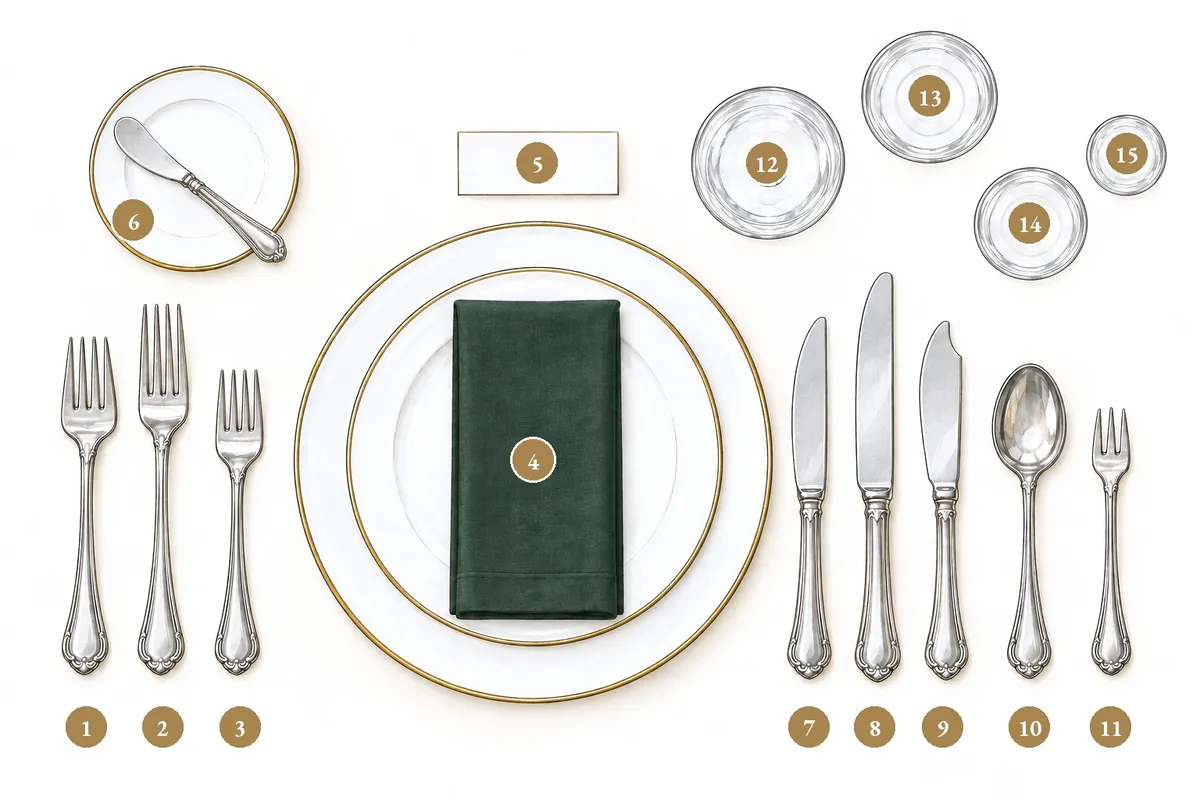
- Fish fork
- Dinner fork
- Salad fork (salad comes after the main course)
- Service plate (charger) with napkin
- Place card
- Bread plate and butter spreader
- Salad knife
- Dinner knife
- Fish knife
- Soup spoon
- Oyster fork (the only fork on the right)
- Water goblet
- Red wine
- White wine
- Champagne flute or sherry
The outside-in rule
The table is laid in the order the food will arrive. The fork and knife furthest from your plate are for the first course. When that plate goes, the next pair in is yours. That is the whole secret.
Read this way, the setting above is a menu. Oysters first, with the little fork on the far right. Then soup, then fish, then the main course, then salad, which at a formal American dinner comes after the main course. That is why the salad fork sits closest to the plate.
I laid the Family’s table with a wooden ruler for forty years, which I am told was excessive. In all that time only one guest began with the wrong fork, and he was a professor of medieval history. He did it with such confidence that half the table followed him.
The details that catch people out
- The oyster fork is the only fork on the right. Everything else with tines lives on the left.
- Bread on the left, drink on the right. Under the table, touch each thumb to its forefinger: the left makes a small b, the right a d.
- Your napkin goes in your lap as soon as you sit down. At a formal dinner in a private home, wait until your host has unfolded theirs.
- Once a knife, fork or spoon has been used, it rests on a plate. It never goes back on the tablecloth.
- The dessert fork and spoon lie above your plate or arrive with the pudding. Leave them alone until it does.
The everyday place setting
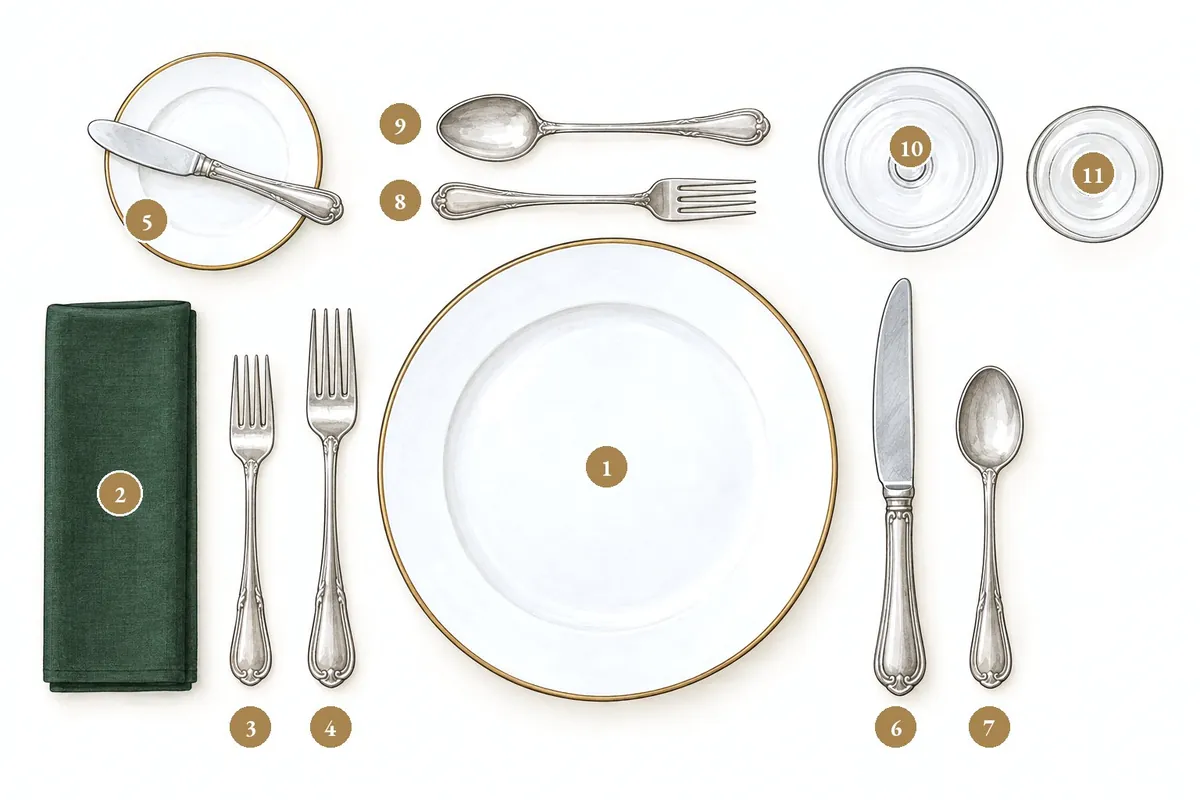
- Dinner plate (salad plate may sit on top to start)
- Napkin, to the left of the forks
- Salad fork (outside: salad comes first)
- Dinner fork
- Bread plate and butter knife
- Dinner knife, blade facing the plate
- Teaspoon
- Dessert fork (handle to the left)
- Dessert spoon (handle to the right)
- Water glass
- Wine glass
At home the salad usually comes first, so the salad fork moves to the outside. The principle never changes: outside in.
Lost anyway?
Pause, and watch your host. Nobody has ever been faulted for doing exactly what the host does. And when you have finished, your knife and fork have one last job to do, which is explained in Knife and fork signals.
Questions
Which fork do I use first at a formal dinner?
The one furthest from your plate. Cutlery is laid in the order the food arrives, so you work from the outside in, one pair per course.
Which side does the bread plate go on?
The left. Your bread plate is on your left and your glasses are on your right. Touch each thumb to its forefinger under the table: the left hand makes a b, for bread, and the right makes a d, for drink.
Where do the dessert fork and spoon go?
Above the plate, the fork with its handle to the left and the spoon with its handle to the right. At some dinners they arrive with the pudding instead. Either way, leave them alone until dessert.
Why is the salad fork closest to the plate in a formal setting?
Because at a formal American dinner the salad is served after the main course. The fork for the last course sits nearest the plate.